Display Jupyter Notebooks with Academic
Learn how to blog in Academic using Jupyter notebooks
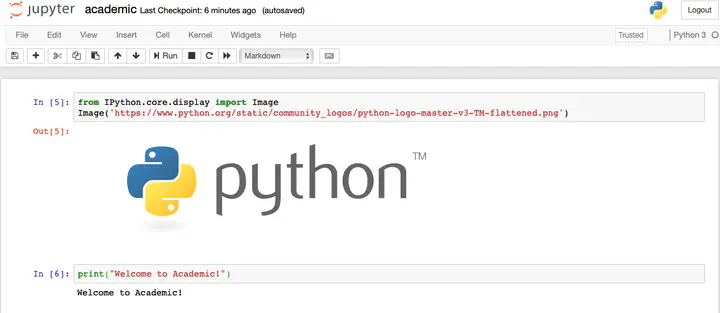
from IPython.core.display import Image
Image('https://www.python.org/static/community_logos/python-logo-master-v3-TM-flattened.png')

print("Welcome to Academic!")
Welcome to Academic!
Install Python and JupyterLab
Install Anaconda which includes Python 3 and JupyterLab.
Alternatively, install JupyterLab with pip3 install jupyterlab.
Create or upload a Jupyter notebook
Run the following commands in your Terminal, substituting <MY-WEBSITE-FOLDER> and <SHORT-POST-TITLE> with the file path to your Academic website folder and a short title for your blog post (use hyphens instead of spaces), respectively:
mkdir -p <MY-WEBSITE-FOLDER>/content/post/<SHORT-POST-TITLE>/
cd <MY-WEBSITE-FOLDER>/content/post/<SHORT-POST-TITLE>/
jupyter lab index.ipynb
The jupyter command above will launch the JupyterLab editor, allowing us to add Academic metadata and write the content.
Edit your post metadata
The first cell of your Jupter notebook will contain your post metadata (front matter).
In Jupter, choose Markdown as the type of the first cell and wrap your Academic metadata in three dashes, indicating that it is YAML front matter:
---
title: My post's title
date: 2019-09-01

# Put any other Academic metadata here...
---
Edit the metadata of your post, using the documentation as a guide to the available options.
To set a featured image, place an image named featured into your post’s folder.
For other tips, such as using math, see the guide on writing content with Academic.
Convert notebook to Markdown
jupyter nbconvert index.ipynb --to markdown --NbConvertApp.output_files_dir=.
Example
This post was created with Jupyter. The orginal files can be found at https://github.com/gcushen/hugo-academic/tree/master/exampleSite/content/post/jupyter
Dr Sara Gandy
Research Associate
My research primarily focuses on understanding the ecological drivers of tick-borne diseases to provide insights on the mechanisms involved in transmission cycles, especially on the interactions between ticks, hosts and pathogens. My research includes investigating the impacts of environmental changes (woodland restoration, rewilding) and host community composition (deer, rodent and birds) on tick-borne diseases risks in the UK. Some of my findings uncovered an opposing effect of deer densities on Lyme disease hazard through their positive effects on tick density and negative effects on infection prevalence. I also published work looking at spatiotemporal changes in tick distribution using passive surveillance data and I have been leading the National Tick Survey, which involves collaborating with stakeholders in thirty National Parks and recreational areas to collect ticks and test them for various tick-transmitted pathogens between 2021 and 2024. The goal is to understand disease hazard and temporal variation in areas visited by members of the public and deliver tick awareness messages.