Poster presentation at Society for Vector Ecology in October 2025
Abstract
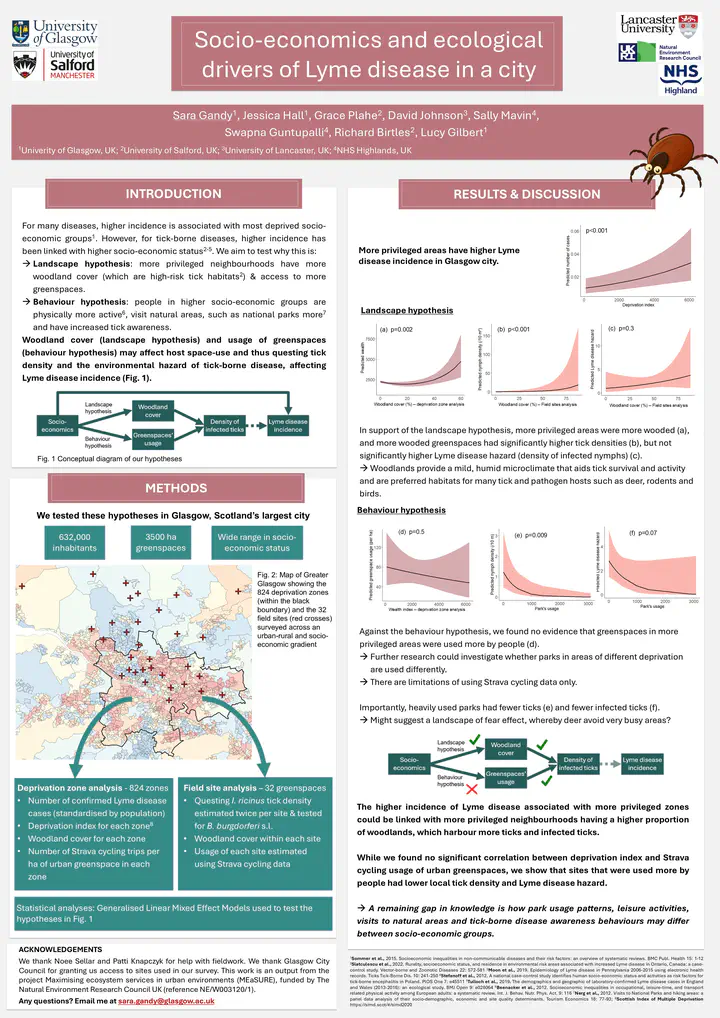
In response to the growing need for ecosystem services, many cities have adopted nature-based solutions such as tree planting and green corridors to increase biodiversity and improve climate change resilience. However, these efforts may inadvertently increase tick-borne disease risk by attracting wildlife tick hosts. Our study focuses on the city of Glasgow in Scotland and examines both ecological and socioeconomic drivers of deer abundance, tick density, Lyme disease hazard and Lyme disease incidence across the city and its surrounding rural areas. We found that less deprived areas exhibit higher rates of Lyme disease incidence and tend to have greater woodland cover, suggesting that people in these areas may live closer to habitats favourable for both tick and pathogen hosts. To explore ecological processes further, we surveyed 32 greenspaces and woodlands along an urban-rural and deprivation gradient. Using structural equation modelling, we found that tick density and Lyme disease hazard are significantly influenced by woodland cover, built-up cover and deprivation index within a 1000 m radius of surveyed sites. These findings underscore a key challenge for urban planning: while rewilding and greenspace expansion support biodiversity and climate resilience, they may also elevate tick-borne disease risks. Additionally, the influence of socioeconomic factors on Lyme disease incidence calls for deeper research into how behaviour, exposure and access to healthcare may shape risk. Future urban design must carefully balance ecological benefits with public health considerations to minimize unintended consequences of rewilding efforts.

Dr Sara Gandy
Research Associate
My research primarily focuses on understanding the ecological drivers of tick-borne diseases to provide insights on the mechanisms involved in transmission cycles, especially on the interactions between ticks, hosts and pathogens. My research includes investigating the impacts of environmental changes (woodland restoration, rewilding) and host community composition (deer, rodent and birds) on tick-borne diseases risks in the UK. Some of my findings uncovered an opposing effect of deer densities on Lyme disease hazard through their positive effects on tick density and negative effects on infection prevalence. I also published work looking at spatiotemporal changes in tick distribution using passive surveillance data and I have been leading the National Tick Survey, which involves collaborating with stakeholders in thirty National Parks and recreational areas to collect ticks and test them for various tick-transmitted pathogens between 2021 and 2024. The goal is to understand disease hazard and temporal variation in areas visited by members of the public and deliver tick awareness messages.