Poster presentation at the Environmental and Ecological Statistics conference in July 2025
Abstract
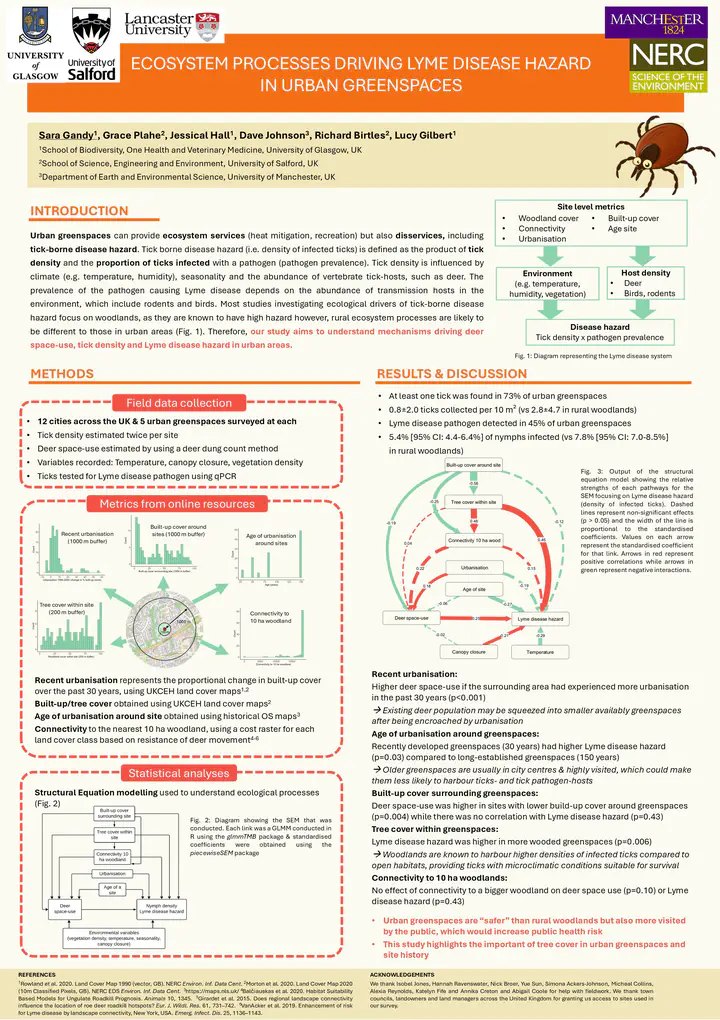
Urban greenspaces can provide ecosystem services (heat mitigation, recreation) but also disservices, including tick-borne disease hazard. Most studies investigating ecological drivers of tick-borne disease hazard focus on woodlands, as they are known to have high hazard however, rural ecosystem processes are likely to be different to those in urban areas. In this study, we aimed to understand mechanisms driving deer space-use, tick density and Lyme disease hazard in urban areas. We surveyed urban greenspaces and surrounding hinterland sites across 12 towns in England and Scotland and used Structural Equation Modelling to investigate how connectivity, tree cover, built-up cover and recentness of urbanisation affected deer space-use, tick density and Lyme disease hazard.

Dr Sara Gandy
Research Associate
My research primarily focuses on understanding the ecological drivers of tick-borne diseases to provide insights on the mechanisms involved in transmission cycles, especially on the interactions between ticks, hosts and pathogens. My research includes investigating the impacts of environmental changes (woodland restoration, rewilding) and host community composition (deer, rodent and birds) on tick-borne diseases risks in the UK. Some of my findings uncovered an opposing effect of deer densities on Lyme disease hazard through their positive effects on tick density and negative effects on infection prevalence. I also published work looking at spatiotemporal changes in tick distribution using passive surveillance data and I have been leading the National Tick Survey, which involves collaborating with stakeholders in thirty National Parks and recreational areas to collect ticks and test them for various tick-transmitted pathogens between 2021 and 2024. The goal is to understand disease hazard and temporal variation in areas visited by members of the public and deliver tick awareness messages.